Questions to Ask on a First Date, According to Research
Good first-date questions are mostly follow-ups. In speed-dating research, people who asked more follow-up questions got more second-date yeses, and strangers found deep questions less awkward than they expected. Here's a question ladder, follow-up examples, and what to skip.
The best questions to ask on a first date are mostly follow-ups: you start with something light, then ask about what they just told you, and later try one or two deeper questions. That order is backed by two studies. In a 2017 speed-dating analysis, people who asked a higher share of follow-up questions got more “yes, I'd see them again” answers. In a 2022 set of experiments, strangers expected deep questions to feel awkward, and they turned out to be less awkward and more connecting than predicted.
This post comes from the team behind Blurry, a dating app where profile photos start blurred and clear up as you talk. Below: what the two studies actually found, a question ladder you can use tonight, how to turn any answer into a follow-up, and the questions to save for later.
What does research say about first-date questions?
Two studies are worth knowing, and both were published in the Journal of Personality and Social Psychology.
Huang, Yeomans, Brooks, Minson & Gino (2017), “It doesn't hurt to ask.” The researchers ran two experiments where strangers chatted online for 15 minutes, and they also analyzed recorded speed dates. In a 4-minute speed date, a person asked about 9.8 questions on average, and 4.5 of them were follow-up questions, meaning questions about something the other person had just said. The people who asked a higher share of follow-ups got more “yes” answers from their dates. The authors estimated that asking 8% more follow-up questions would add roughly one extra match over 20 speed dates.
Kardas, Kumar & Epley (2022), “Overly shallow?” Across a series of experiments, people predicted how awkward and how close a conversation with a stranger would feel, then rated it afterward. Deep conversations generally turned out less awkward and more connecting than people expected. In one study, 89 pairs of strangers at a campus event talked for about 10 minutes using five question cards, some shallow (“What's the best TV show you've seen in the last month?”) and some deep (“For what in your life do you feel most grateful?”).
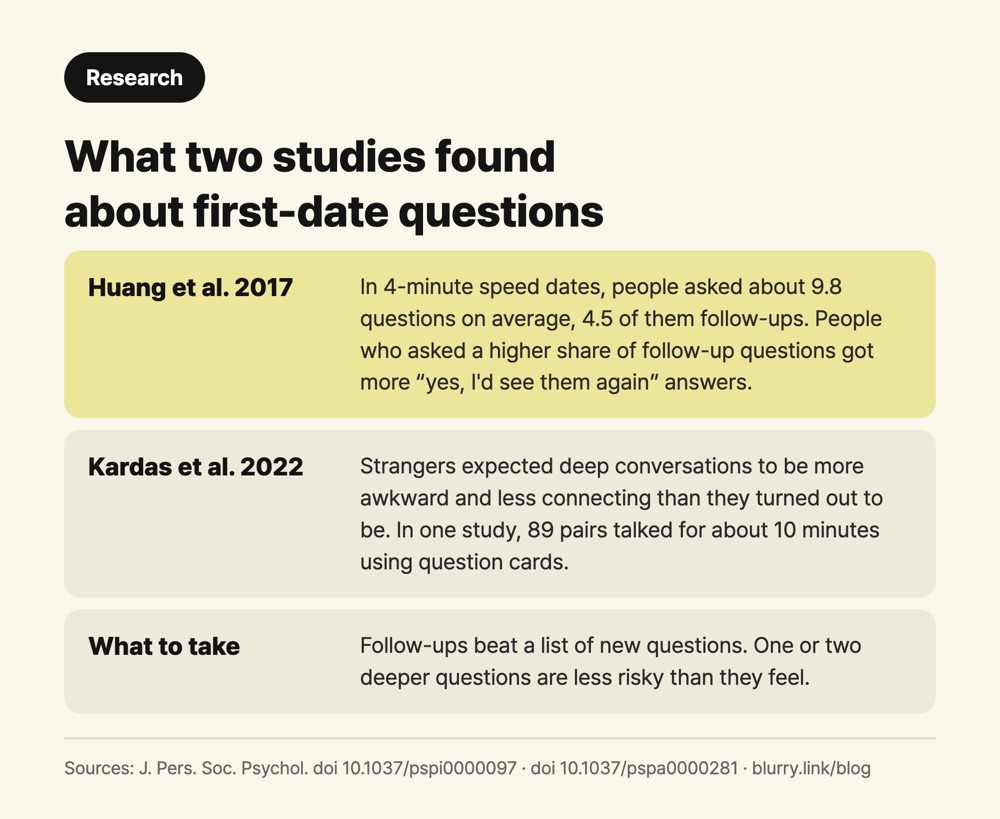
Neither study looked at dinner dates directly, and the Kardas results had one odd wrinkle: in that campus study, people in the deep-talk group reported slightly more loneliness right after, which the authors didn't predict. One reasonable read is that opening up and then stopping after 10 minutes can leave you wanting more. On a real date, that's not a bad problem to have.
A question ladder for a first date
Don't open with the heaviest question you know. Climb. The ladder below is our adaptation of the research for a real date, not something the studies tested as-is.
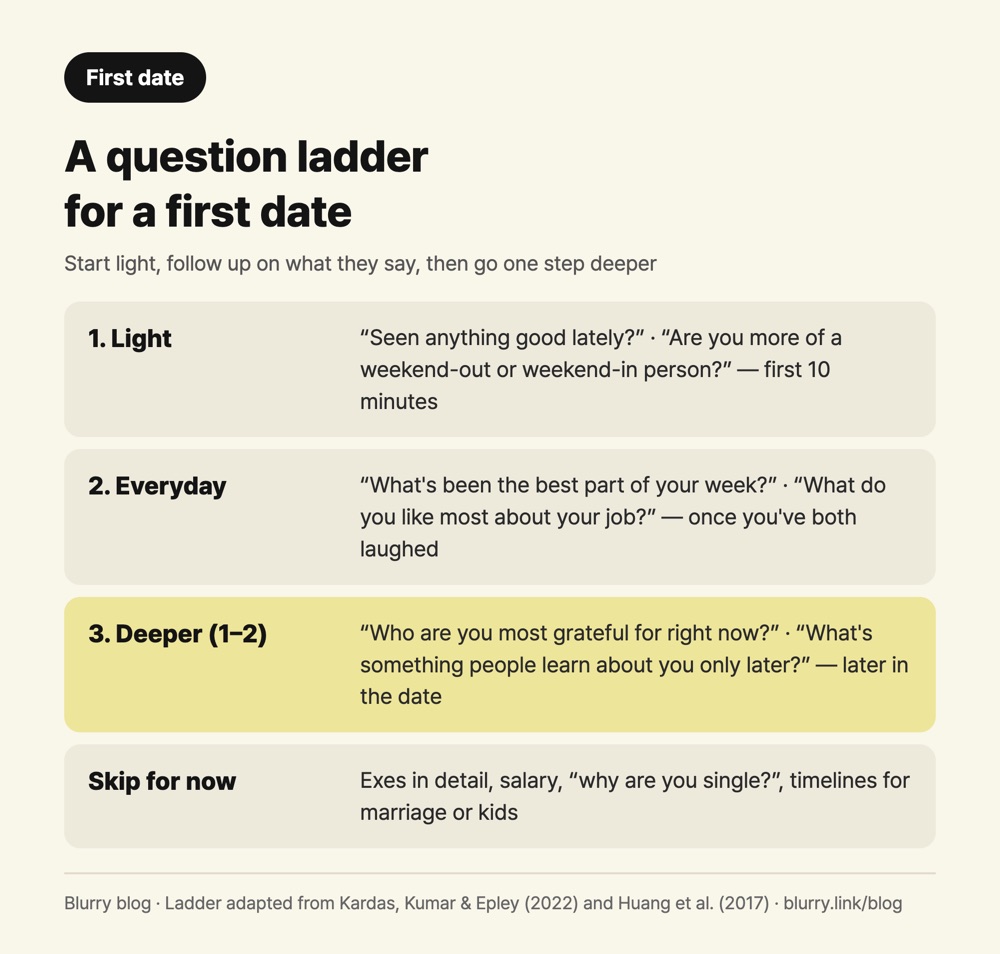
| Step | Example questions | When |
|---|---|---|
| 1. Light | “Seen anything good lately?” · “Are you a weekend-out or weekend-in person?” · “How did you end up living around here?” | The first 10 minutes |
| 2. Everyday | “What's been the best part of your week?” · “What do you actually like about your job?” · “What are you into lately that you didn't expect?” | Once you've both laughed at least once |
| 3. Deeper (pick 1–2) | “Who are you most grateful for right now?” · “What's something people only learn about you later?” · “What's a small thing that makes a day good for you?” | Later in the date, or over a second drink or coffee |
| Skip for now | Exes in detail, salary, “why are you single?”, timelines for marriage or kids | Not on date one |
How do you turn an answer into a follow-up?
Take one specific word from their answer and ask about it. That's all a follow-up is, and it's the move the speed-dating study rewarded.
| They say | New-topic question (weaker) | Follow-up (stronger) |
|---|---|---|
| “I just got back from visiting my sister.” | “Cool. Do you travel a lot?” | “Where does she live? Are you two close?” |
| “Work's been crazy, we had a big launch.” | “What do you do for fun?” | “What did you launch? Was it worth the crazy part?” |
| “I've been trying to get into running.” | “What kind of music do you like?” | “What got you started? Do you actually enjoy it yet?” |
| “I'm kind of a homebody.” | “Have you been to that new bar downtown?” | “What's a perfect night in for you?” |
Follow-ups also take pressure off you. You don't need a list of 50 questions in your head. You need to listen for one thing worth asking about. And give something back: if you only ask and never share, it starts to feel like an interview.
Which questions should you skip on a first date?
Skip questions that ask the other person to defend or rank their life before they know you. These tend to make a first date feel like a screening:
- “Why are you still single?”
- Detailed questions about their ex or why it ended
- How much they earn
- When they want to get married or have kids
- Very personal deep questions from lists like the 36 questions, such as when they last cried in front of someone
If they bring up any of these themselves, it's fine to follow their lead. If the ex question comes at you, here's how to answer “when was your last relationship?”
FAQ
How many questions should you ask on a first date?
There's no target number. In the speed-dating data, people asked about 9.8 questions in 4 minutes, but what mattered was the share of follow-ups, not the total. Aim for a back-and-forth where you ask, listen, share something of your own, and ask about what they said.
Is it okay to ask deep questions on a first date?
One or two, yes, once the conversation is warm. The 2022 study found people overestimate how awkward deep questions will be. Start light, and save the deeper question for later in the date.
What if the conversation dies anyway?
Go back to something they said earlier and ask more about it (“Wait, you said you're learning to cook. What's the best thing you've made?”). Changing the setting helps too, like moving from dinner to a short walk. For drinks dates specifically, see our first-date drinks rules.
Sources
- Huang, K., Yeomans, M., Brooks, A. W., Minson, J., & Gino, F. (2017). It doesn't hurt to ask: Question-asking increases liking. Journal of Personality and Social Psychology, 113(3), 430–452. doi.org/10.1037/pspi0000097
- Kardas, M., Kumar, A., & Epley, N. (2022). Overly shallow?: Miscalibrated expectations create a barrier to deeper conversation. Journal of Personality and Social Psychology, 122(3), 367–398. doi.org/10.1037/pspa0000281
If you met on an app and haven't picked a date yet, our data on keeping a dating app conversation going covers the step before this one.
Since this is Blurry's blog: Blurry is a dating app where photos start blurred and get clearer the more you talk, so you've usually asked a few good questions before you ever see a face. → Blurry