How to Keep a Dating App Conversation Going (Data From 1,899 Chats)
We counted 1,899 Blurry chats. 31.5% never got past the opener's first message, but 77.5% of chats that got any reply went on to 10+ messages. Here's where conversations die, what helps, and whether double texting works.
The hardest part of keeping a dating app conversation going is getting the first reply. In 1,899 Blurry chats, 31.5% never got past the opener's first message, but once the other person replied, 77.5% of chats went on to 10 or more messages, and about half of those passed 60. So most of your effort belongs in a first message that's easy to answer, and in the next two or three messages after the reply.
This is a data post from the Blurry team. Blurry is a dating app where profile photos start blurred and clear up as you talk. We looked at every chat started between August 2 and October 31, 2026 that had at least one message: 1,899 chats. We only counted timestamps, message counts, and whether a message came from the same person or the other one. Nobody read any message content, and nothing here can identify a user.
Where do dating app conversations die?
Mostly at the very start. Here's how many messages each chat had in total, both people combined.
| Messages in the chat | Share of chats | What happened |
|---|---|---|
| 1 | 31.5% (598) | The opener's first message, then nothing |
| 2 | 6.5% (123) | One back-and-forth, or two unanswered messages |
| 3–4 | 6.1% (116) | Stalled after a few lines |
| 5–9 | 7.0% (132) | A short chat that faded |
| 10–19 | 8.1% (153) | A real conversation, but brief |
| 20–59 | 15.9% (302) | A solid conversation |
| 60 or more | 25.0% (475) | A long conversation |
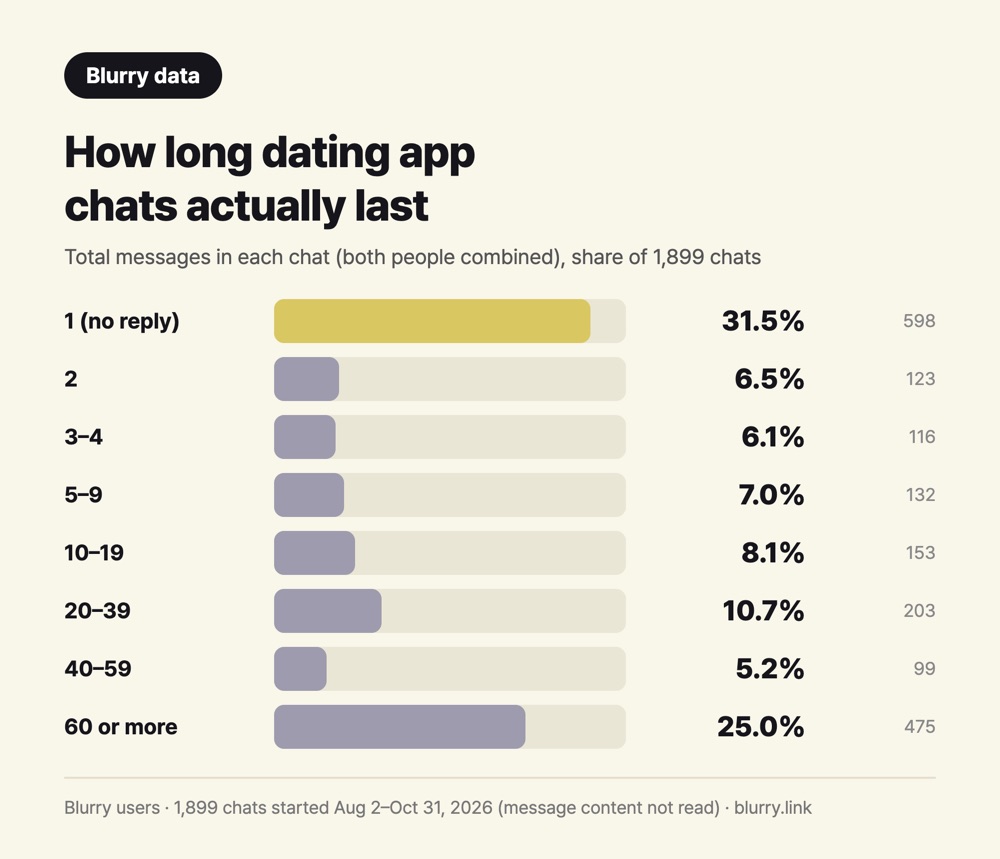
The shape is a U. Chats tend to either die immediately or go long. The middle, where a chat limps along for 5 to 9 messages and then fades, is smaller than most people expect: 7.0%.
Once they reply, how likely is the chat to keep going?
Very likely. 1,200 of the 1,899 chats got at least one reply (63.2%). Of those 1,200, 930 reached 10 or more messages with both people talking (77.5%). And of the 930 that reached 10, 475 went past 60 messages (51.1%).
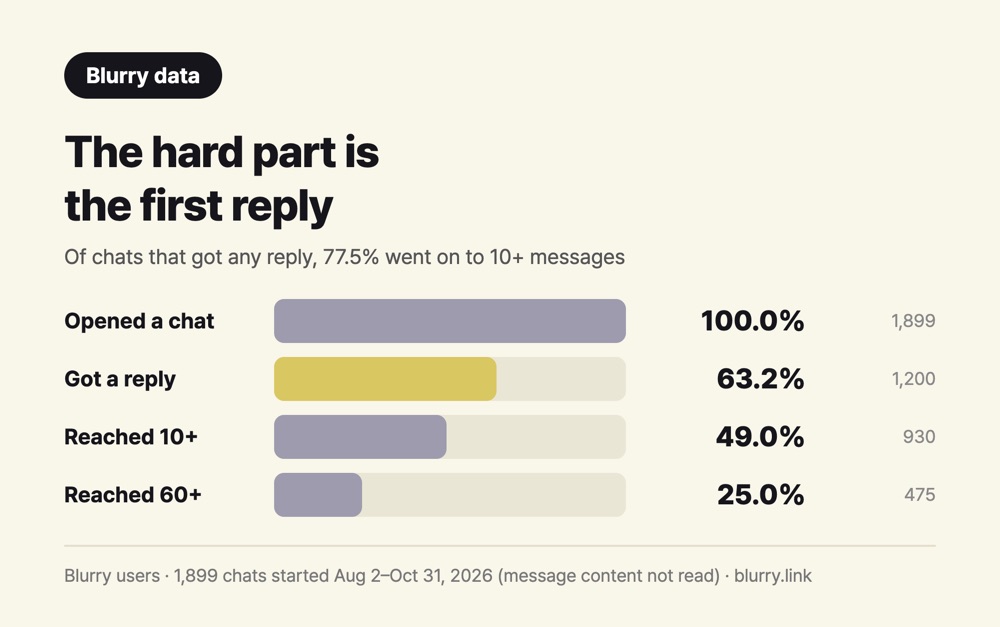
That changes where to put your energy. If you've already got a reply, you're past the steepest drop. The next job is to make the first few exchanges easy to answer, so the chat reaches double digits.
What should you actually say after the first reply?
We didn't read anyone's messages, so this part is our advice, not a measurement. The pattern that keeps chats moving is simple: answer what they asked, add one small detail about you, and hand them an easy question back.
| They said | Dead end | Keeps it going |
|---|---|---|
| “Haha hey! Not much, just got home.” | “Cool.” | “Same, long day. I'm making pasta and pretending it's a hobby. What's your go-to lazy dinner?” |
| “I went hiking this weekend.” | “Nice, I like hiking too.” | “Where'd you go? I keep saying I'll do a sunrise hike and then I keep sleeping in.” |
| “I'm a nurse.” | “Oh wow.” | “Respect. Night shifts or days? I feel like that changes your whole life schedule.” |
Two things kill chats quietly: one-word answers that leave nothing to respond to, and a string of interview questions with nothing about yourself in between. If you've traded 15 or 20 messages and it's going well, suggest a short plan. Our guide on how long to talk before meeting covers the timing.
Does sending two messages in a row help?
At the opening, it looked like it. When the opener sent two messages within the first 5 minutes (before any reply), 72.6% got a reply (156 of 215) and 62.8% reached 10+ messages. With a single message, it was 62.0% (1,026 of 1,656) and 47.2%.
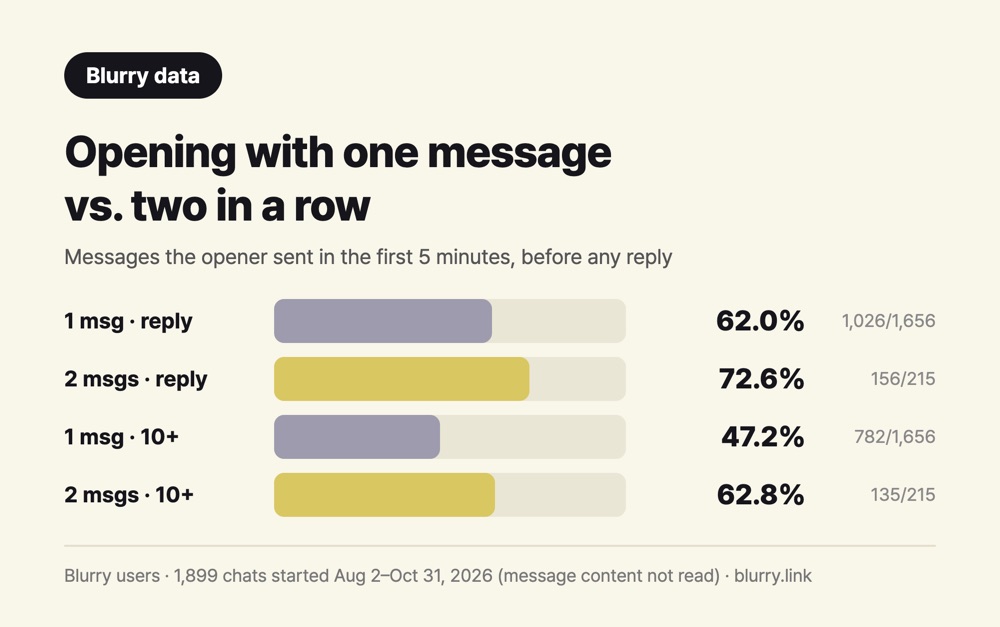
Be careful with this one. It's a pattern, not proof. People who bother to send a second line may just be more engaged in general. Still, there's no sign it hurts. A natural way to do it: a short hello, then a real question as its own bubble.
- “Hey!” then “Okay, I have to ask about the dog in your third photo. What's their name?”
- “Hi Sam” then “You said you're learning to cook. What's the best thing you've made so far?”
Should you double text if they don't answer?
Once is fine, but don't count on it. Double texting after a long silence was rare in our data, so treat these numbers as rough. Of 1,137 chats with no reply in the first hour, only 37 openers sent another message an hour or more later, typically after about 18 hours. 8 of those 37 eventually got a reply (21.6%). Among the 1,100 who didn't send again, 39.1% still got a reply later.
That doesn't mean the follow-up scared people off. People usually double text when a chat already looks cold, so the two groups aren't comparable. The practical read: a single, light follow-up with a new question is okay. Sending a third or fourth message to an unanswered chat isn't worth it. For more on waiting, see how fast to reply on dating apps.
FAQ
How many messages before asking someone out on a dating app?
There's no magic number, but in our data the chats that reached 10 messages were the ones most likely to keep going. Somewhere after that, once you've had a couple of real back-and-forths, is a fair time to suggest meeting.
Why do dating app conversations die after a few messages?
In our data, most don't die in the middle. They die at message one. Only 7.0% of chats faded out between 5 and 9 messages. If your chats keep stalling early, look at whether your replies give the other person something easy to answer.
Is it bad to double text on a dating app?
One follow-up isn't bad. Make it a new, easy question rather than “??” or “hello?”. If that one goes unanswered too, move on.
Limits of these numbers
- These are Blurry users only, so they won’t match every app exactly. Users in Korea and other countries are counted together.
- We read up to the first 60 messages of each chat, so “60 or more” is the top bucket.
- Correlation, not cause: engaged people send more messages and reply more, which drives several of these patterns.
- Message content wasn't analyzed. Counts, timestamps, and sender (same person or not) only.
Source: Blurry (Hyperity) internal count, November 4, 2026. If you cite it, please write “Blurry, 1,899 chats, Aug–Oct 2026.” If your openers aren't landing, start with what to text first.
Since this is Blurry's blog: Blurry is a dating app where photos start blurred and get clearer the more you talk, so the conversation comes first. → Blurry