Dating App for Serious Relationships: What to Check, What Research Says, and How to Show You're Serious
Looking for a dating app for a serious, long-term relationship? Five things to check on any store page, what two large US surveys found about couples who met online, and simple messages that show you're serious without coming on too strong.
There's no single dating app that guarantees a serious relationship, but you can tell which apps are built for one. Check five things on the store page: whether you can state what you're looking for, how much a profile says beyond photos, how many people you see a day, how a conversation starts, and what safety tools exist. Then use the app in a way that matches your intent: say it plainly in your profile, ask real questions, and suggest meeting within a week or two. Large US surveys found that couples who met online do about as well as, or slightly better than, couples who met offline.
Quick disclosure: this post is written by Hyperity, the company that makes Blurry, a conversation-first dating app. Because of that, we don't rank apps, give star ratings or quote prices. What we say about other apps comes only from their Google Play descriptions as of November 24, 2026.
Do relationships that start on dating apps actually last?
This is usually the first worry: if you meet someone on an app, is it less likely to turn into something real? Two large US studies looked at it.
- More than one-third of US marriages from 2005 to 2012 began online. A University of Chicago team (Cacioppo et al., 2013, PNAS) surveyed a nationally representative sample of 19,131 people who married in those years.
- Breakups were slightly less common. 5.96% of people who met their spouse online had separated or divorced, compared with 7.67% of those who met offline. After controlling for year of marriage, age, education, income and other factors, the gap shrank but stayed statistically significant.
- Satisfaction was slightly higher. Among people still married, those who met online rated their marriage 5.64 on a 1 to 7 scale, versus 5.48 for those who met offline.
- Online is now the most common way couples meet. A Stanford-led study (Rosenfeld, Thomas & Hausen, 2019, PNAS) found that among heterosexual US couples who met in 2017, 39% met online, up from 2% in 1995. Meeting through friends fell from 33% to 20% over the same period.
Two honest caveats. First, the differences in the 2013 study are small, and the survey was commissioned by eHarmony; one author was a scientific advisor to the company, which the paper discloses. Second, the 2019 study's authors say that in their data, how couples met did not significantly change breakup rates or relationship quality. Put together, the fair reading is this: meeting on an app doesn't make a relationship weaker. Neither study shows that a particular app causes a better relationship. Who you meet and how the two of you treat each other matter more than the venue.
5 things to check before you pick a dating app for something serious
Almost every app says it's for "meaningful connections" now, so the slogan won't help you decide. These five checks will. You can do all of them on the store page or in the first ten minutes after signing up.
- Can you say what you want? Look for a field like "looking for" or "relationship goals." If both of you fill it in, you skip a lot of mismatched chats.
- How much does a profile say beyond photos? Written prompts, values, lifestyle questions or voice notes give you something real to start a conversation with. More text usually means better first messages.
- How many people do you see a day? Some apps give an open feed, others a short daily batch. If you tend to keep ten chats going and finish none of them, a smaller daily number helps you focus.
- How does a conversation start? Some apps match on a mutual like, some let you comment on one part of a profile, and some start with a chat before photos are fully shown. Pick the one that matches how you actually make a first impression.
- What safety tools are there? Reporting, blocking, photo or ID verification and chat moderation. These matter more for serious dating, because you'll eventually share your number, workplace and real name.
One more practical check: read what the free version includes. Most apps let you match and chat for free and charge for extras like more likes or seeing who liked you. The exact line changes often, so check it in the app rather than trusting an old review.
Three formats you'll run into
Instead of a ranking, it's more useful to know the formats. Each suits a different kind of person.
| Format | What comes first | Who it suits |
|---|---|---|
| Prompt-heavy profiles | Photos plus written answers you can reply to | Men who like opening with a comment on something specific |
| Daily batch | A small set of suggested people each day | Men who want fewer, more focused chats |
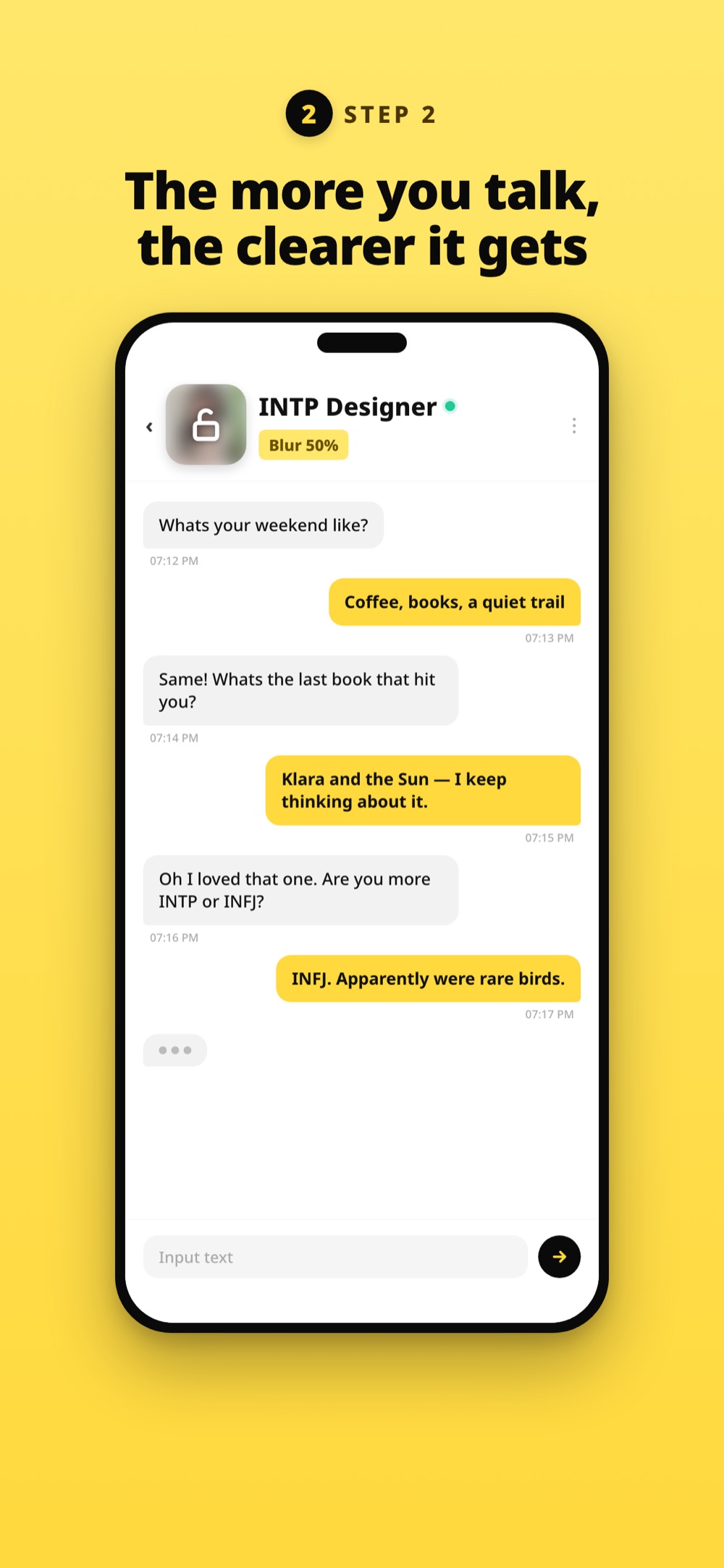
| Conversation first, gradual reveal | A chat, with photos getting clearer as you talk | Men who care most about whether the conversation clicks and whether values match |
For an example of the first format: Hinge's Google Play description (checked November 24, 2026) calls it "the online dating app designed to be deleted" and describes profiles with prompts that show personality through text, photos, video and voice, plus a way to state your dating goals. That's the format, not a ranking.
This is the Blurry blog, so one mention of our own app. Blurry is in the third format. Every profile starts blurred, you and your match chat, and the photos get clearer as the conversation goes on. People are suggested by shared values, interests, MBTI and lifestyle, according to our store description. It suits men who want to get to know someone gradually, care about privacy, or simply find it easier to make a first impression in writing. → Try Blurry
How to show you're serious without coming on too strong
The app is only half of it. The other half is how you use it. A lot of guys who want something real end up looking like they don't, because their profile and first messages look the same as everyone else's. Here's what to do instead.
1. Say it once, plainly, in your profile
One line is enough. You don't need a long paragraph about it.
- "Looking for something long-term. Happy to start with a good conversation and see."
- "Here to meet someone I'd want to introduce to my friends."
Leave it there. Saying it calmly once comes across as confident. Repeating it in every message comes across as pressure.
2. Open with a real question about her profile
"Hey" or "how's your week" gives her nothing to work with. Pick one thing she wrote or showed and ask about it in a way that needs more than one word to answer.
- "You said Sunday mornings are for long walks. City walk or somewhere with trees?"
- "Your favorite book is a heavy one. What made you pick it up?"
More openers and how to keep them going: how to start a conversation on a dating app.
3. Ask what she's looking for after a few exchanges, not in message one
Asking "so what are you looking for?" as your opener feels like a form. After four or five back-and-forths it feels natural, especially if you go first:
- "I'm on here hoping to find something that lasts, honestly. What brought you to the app?"
If her answer is "just seeing what's out there," that's not a no. It just means you'll learn more from how the next week goes than from labels.
4. Suggest meeting within a week or two
Serious doesn't mean slow forever. Endless texting tends to make the first meeting harder, not easier. When the chat has a rhythm, make a concrete, low-pressure offer:
- "I'm enjoying this. Want to grab coffee Saturday afternoon? An hour, near you."
A specific day and a short time make it easy to say yes. Timing details are in how long to talk on a dating app before meeting.
5. Be consistent, not intense
Replying at a steady pace, remembering what she told you last time and following up on it ("How did the presentation go?") says "serious" far more than long messages or compliments do.
Signs you're both looking for the same thing
| Good sign | Worth watching |
|---|---|
| She asks questions back, not only answers yours | Every topic is started by you |
| She brings up things you said earlier | The chat resets to "how was your day" each time |
| A suggestion to meet gets a time, or a new time offered | A suggestion gets "maybe sometime" with nothing after it |
| She mentions friends, family or plans further out | Conversation stays on tonight only |
None of these is proof on its own. Look at the pattern over a week or two. If it's not lining up after a couple of honest tries, it's fine to wish her well and move on. Once you've met a few times and it's going well, here's how to have the next talk: how many dates before asking her to be your girlfriend.
FAQ
What is the best dating app for serious relationships?
No study ranks apps by how many long-term couples they produce. Use the five checks above and pick the format that matches you. The research above found that meeting online in general does not make relationships weaker.
Are there free dating apps for serious relationships?
Most dating apps let you create a profile, match and chat for free and charge for extras. What's free changes often, so read the current store page or the in-app plans before deciding.
Is it a bad idea to say I want something serious on my profile?
No. One calm, clear line helps people with the same goal find you. Just don't make it the main topic of every conversation.
Do couples who meet online stay together?
In the 2013 US survey, people who met their spouse online had a slightly lower separation or divorce rate (5.96% vs 7.67%). The 2019 study found no significant difference in breakups or quality by how couples met. Either way, online isn't a disadvantage.
Blurry is a dating app where the conversation comes first and faces come later. If you'd like to know how someone thinks and talks before you see them → Blurry. More reading: slow dating app · dating app for introverts · how to get out of the talking stage.
Sources
- Cacioppo, J. T., Cacioppo, S., Gonzaga, G. C., Ogburn, E. L., & VanderWeele, T. J. (2013). Marital satisfaction and break-ups differ across on-line and off-line meeting venues. Proceedings of the National Academy of Sciences, 110(25), 10135–10140. doi.org/10.1073/pnas.1222447110 (open access: PMC3690854)
- Rosenfeld, M. J., Thomas, R. J., & Hausen, S. (2019). Disintermediating your friends: How online dating in the United States displaces other ways of meeting. Proceedings of the National Academy of Sciences, 116(36), 17753–17758. doi.org/10.1073/pnas.1908630116 (open access: PMC6731751)
- Google Play store descriptions for Hinge and Blurry, checked November 24, 2026.